BESS: Battery Energy Storage System
Store energy. Use it when it matters.
Understand how battery storage works, where it adds value, and what to consider for solar, industrial and backup power applications.
What is BESS?
A Battery Energy Storage System (BESS) stores electrical energy in rechargeable batteries and releases it when needed. Batteries work together with power conversion, controls and protection to deliver a complete energy storage solution.
A BESS can charge from solar generation or the electricity grid, depending on its design and operating permissions. It can also form part of a hybrid system with a generator. This flexibility helps a facility align its electricity supply with the timing of its demand.
Charge → store → discharge. A BESS shifts energy in time. It consumes some energy during charging, discharging and auxiliary operation, so the energy delivered is lower than the energy supplied.
How does a BESS work?
- Charge: electricity is directed into the batteries within their permitted operating limits.
- Store and monitor: the Battery Management System monitors cell conditions while thermal management maintains the required environment.
- Dispatch: the Energy Management System schedules charging and discharging according to the operating objective and available capacity.
- Deliver: the Power Conversion System converts battery DC power to AC power for the facility or grid connection.
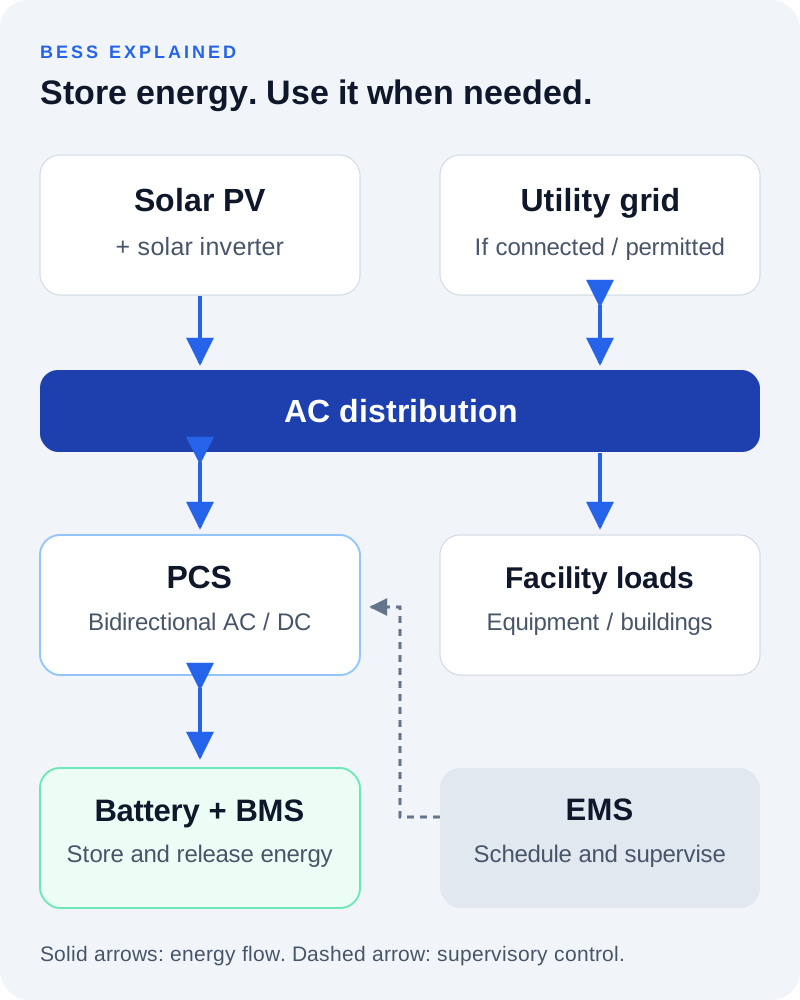
Simplified AC-coupled example. Metering, isolation, switchgear and other protection devices are omitted for clarity. Actual architecture depends on the project.
What is inside a BESS?
- Battery cells, modules and racks: store energy. Chemistry, capacity and enclosure arrangement depend on the application.
- BMS — Battery Management System: monitors voltage, temperature and battery condition, and enforces operating limits.
- PCS — Power Conversion System: manages bidirectional conversion between DC batteries and the AC electrical system.
- EMS — Energy Management System: coordinates operation using site demand, generation, tariffs and reserve requirements.
- Thermal management: provides cooling or heating appropriate to the equipment and site conditions.
- Electrical and safety systems: include protection, isolation, detection and monitoring; transformers and additional switchgear may be required.
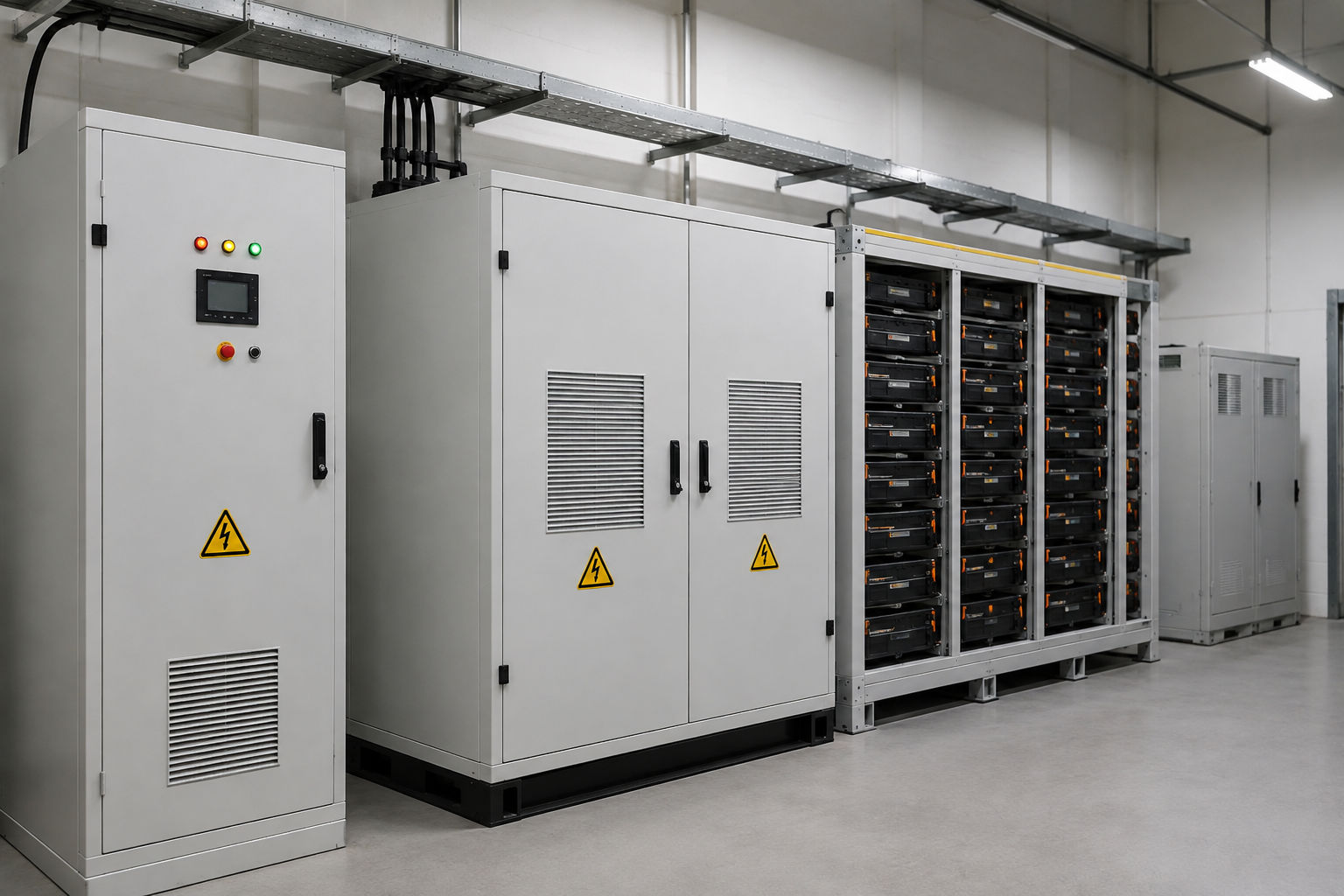
Illustration of battery racks and electrical cabinets, using an existing Norvtech website asset. Equipment shown is illustrative and does not identify a particular installation or product specification.
Power and energy: kW versus kWh
Power (kW or MW) describes how quickly the system can supply or absorb electricity. Energy (kWh or MWh) describes the quantity stored or delivered. Both ratings matter: a large energy capacity does not automatically mean the system can start or support a large instantaneous load.
Illustrative sizing example: a constant 250 kW critical load for two hours needs 500 kWh delivered to the load. Assuming a 90% usable battery window and 95% discharge-path efficiency, nominal energy would start at approximately 500 ÷ (0.90 × 0.95) = 585 kWh, before allowances for auxiliaries, reserve and ageing.
Those percentages are calculation assumptions, not a product specification. The PCS must also support the required power, and motor starting, changing loads and end-of-life capacity need separate assessment. Dividing usable energy by the average load gives a first estimate of duration, not a guaranteed backup time.
Where can BESS add value?
Solar energy shifting
Store available solar surplus and use it later, including after sunset. The benefit depends on the generation profile, site demand and operating constraints.
Peak demand management
Discharge during short demand peaks to reduce the power drawn from the grid. Financial savings depend on the applicable tariff and contract; a lower peak does not automatically produce a lower bill.
Critical-load backup
Support selected loads during an outage when the installation includes suitable transfer, isolation and control arrangements. Grid-forming capability may be needed for islanded operation. Transfer time and load compatibility must be checked.
Hybrid and remote power
Combine solar, batteries and generators for remote facilities such as mining support sites. Coordinated dispatch can reduce generator running hours in suitable operating conditions.
Energy management for industry and commercial buildings
Factories, warehouses, commercial premises and charging facilities can evaluate storage against their load profile, reliability needs and connection capacity.
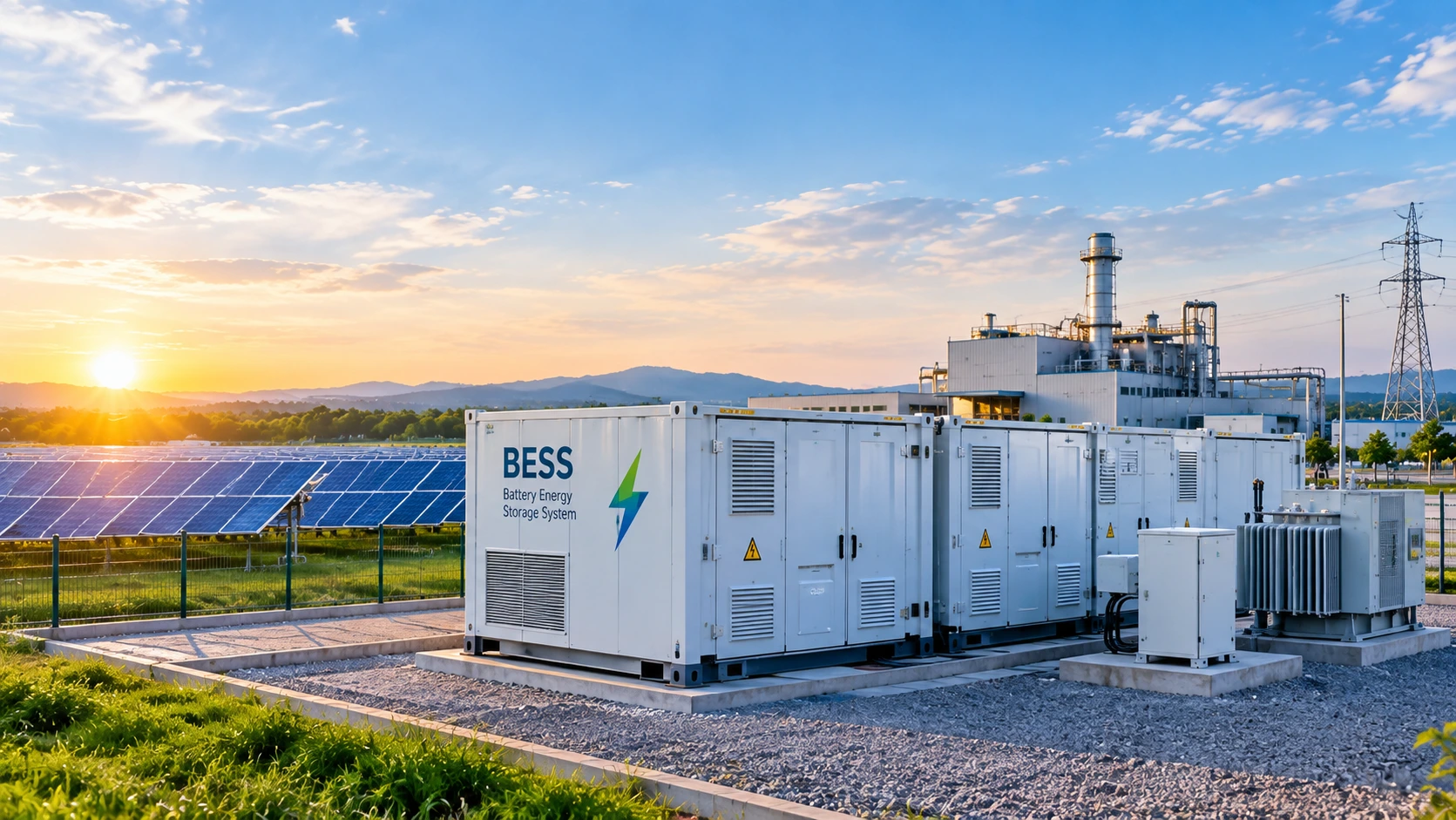
Concept illustration of solar PV with containerized storage. This existing website image illustrates a possible application; it is not presented as a completed Norvtech project.
Choosing the right system
Start with the operating problem, then size the system. Useful inputs include:
- The site location, available space, temperature range and environmental exposure.
- Electricity bills and interval load data covering representative operating periods.
- Critical equipment, starting loads, acceptable interruption time and required backup duration.
- Existing solar, inverter, generator, transformer and grid-connection information.
- The priority: backup, solar self-consumption, demand management, or a defined combination.
Compare usable energy, continuous power, efficiency, controls, warranty conditions and support arrangements. A proposal should identify the measurement point for its ratings and account for auxiliary consumption and capacity reduction over time. System performance can then be checked using metered charge and discharge data.
Safety, operation and maintenance
A BESS requires a site-specific electrical and safety design. Battery selection, thermal management, protective devices, monitoring, installation quality and emergency planning all matter. Lithium-ion systems can present thermal runaway and gas-release hazards, so siting and response planning should involve qualified specialists and the relevant local authorities.
Operation includes reviewing alarms, inspecting equipment, maintaining cooling and protection systems, and keeping maintenance records. Service intervals should follow the equipment manufacturer and the project plan. Access to monitoring and control systems should also be managed appropriately.
What determines the cost?
Project cost includes more than batteries: PCS, controls, protection, civil work, interconnection, commissioning and ongoing service all contribute. Required backup duration and power can lead to very different designs. Evaluate the complete operating plan, replacement assumptions and expected savings before estimating payback.
Frequently asked questions
Does a BESS need solar panels?
No. It can operate as a standalone storage system charged from the grid where permitted. Pairing it with solar is one application.
Will it automatically keep the whole site running during a blackout?
Backup operation must be designed into the system. The supported loads, transfer arrangement, PCS capability and stored energy determine what can continue operating.
Is BESS the same as a UPS?
Some functions overlap, but the required interruption time and power quality must be specified. A BESS installation should not be assumed to meet a particular UPS requirement without confirmation.
How long will the batteries last?
Lifetime depends on chemistry, temperature, operating window, cycling and maintenance. Compare the product warranty, capacity-retention terms and operating assumptions rather than relying on a universal number.
Can BESS work with an existing solar installation?
Often, but compatibility needs assessment. Existing inverter controls, protection, metering and connection requirements influence the choice of AC-coupled or DC-coupled architecture.
Discuss your BESS requirements
Share your site location, electricity usage, critical loads and operating objectives with Norvtech to start a project discussion.
Explore related solutions: Energy Solutions · Solar Panels · Solar Inverters.
Further reading
Technical background for the explanations on this page:
- U.S. Department of Energy — Solar Energy and Storage Basics
- DOE FEMP — Battery Energy Storage Systems: Considerations for Implementation
- NREL — Battery Energy Storage System Evaluation Method
- NREL — Customizable Technical Specifications for Lithium-Ion Battery Storage Projects
- U.S. EPA — BESS Installation and Safety Considerations